Diggy's Adventure Puzzle Game
- 4.4
- Rating
- 10.00M
- Installs
- Free
- Price

 Analysis by App-foxy
I first noticed Diggy's Adventure: Escape Game because it sits between a story-driven adventure and a collection of compact puzzle rooms. After spending time with it, I found that its strongest appeal is not a single brilliant puzzle, but the way exploration, resource decisions, riddles, and light narrative keep feeding into one another. It is the sort of game I can open for a few minutes while waiting, then unexpectedly continue much longer because I want to see what is behind the next blocked passage.
That makes it especially interesting on a shared household device. One person can investigate a maze, another can try a water-connection puzzle, and a younger player can enjoy the colorful presentation without needing to understand every story detail. Still, shared use needs a little common sense: progress, choices, and any purchases should be treated as belonging to the person currently using the game rather than as a communal save that everyone casually edits.
How the adventure feels in everyday play
I find the game easiest to enjoy when I treat each visit as a small expedition rather than a task to finish quickly. This section looks at how its exploration-and-puzzle rhythm fits ordinary breaks, and why a little coordination helps when a device is shared. It also sets up a closer look at the choices that make its world feel like more than a sequence of rooms.
You May Also Like

 Blood Strike: 2.5 Anniversary
Blood Strike’s Loadouts Turn Every Drop Into a Tactical Gamble
A close look at Blood Strike’s custom loadouts: how fast access to signature weapons reshapes its battle royale rhythm, rewards preparation, and narrows the gap between fights.

 Pandora - Music & Podcasts
Pandora’s Music Is Easy to Start, but Harder to Recover
Pandora’s strength is its low-effort path from a seed to a station. Its weak spot is how much confidence it asks you to place in connection, setup, and quiet recovery.

 8 Ball Pool
 Is Built on Rivalries, Rematches, and Routine
A close look at the rivalries, rematches, shared routines, and unanswered safety questions that turn a quick pool match into a persistent mobile community.

 Samsung Music
’s Quiet Strength Is Playing What You Already Own
Its reach comes less from spectacle than from dependable access to a personal library. That simplicity is both the app’s strongest retention engine and its ceiling.

 AccuWeather: Weather Radar
AccuWeather Review: A Quick, Clear Forecast for Everyday Decisions
For everyday plans, the best forecast is the one you can understand quickly. AccuWeather makes rain timing, radar, and local conditions easy to act on, with a few trade-offs.

 Hill Climb Racing
Why Hill Climb Racing Still Turns Crashes Into One More Run
A tiny car, a bumpy hill and one more upgrade: Hill Climb Racing keeps resurfacing because its simple chaos makes every near-miss feel personal.
More From Our News Desk



A good fit for short sessions that can become longer
The basic rhythm is easy to understand. I move through underground areas, clear obstacles, solve puzzles, collect useful items, and follow the story toward the next discovery. The game does not demand the reflexes of an action platformer, so I can play it while relaxing on the sofa or during a short break. The challenge comes from noticing patterns and deciding how to use what is available, not from reacting quickly to enemies.
In a realistic household scenario, I could imagine one person playing after dinner, leaving the device on the table, and another family member taking over later. That works best when the first player explains where they stopped and what they were trying to solve. A quick note such as “the next room needs a closer look” is more useful than simply handing over the device, because the game’s appeal often depends on remembering the logic behind an unfinished puzzle.
The adventure format also gives the game more staying power than a standalone brain teaser. A single riddle might be satisfying, but the surrounding exploration gives me a reason to continue. I am not only solving an isolated challenge; I am trying to open another route, understand the current objective, or reach a new part of the story. That context makes ordinary puzzles feel more meaningful.
What makes the puzzle design different from a normal escape room app
The store summary points toward room escapes and water-connection riddles, but in practice the important distinction is how those puzzles sit inside a broader adventure. I am not simply entering one room, solving it, and returning to a menu. Exploration and progression create a sense of place, while the puzzles interrupt that journey in manageable pieces.
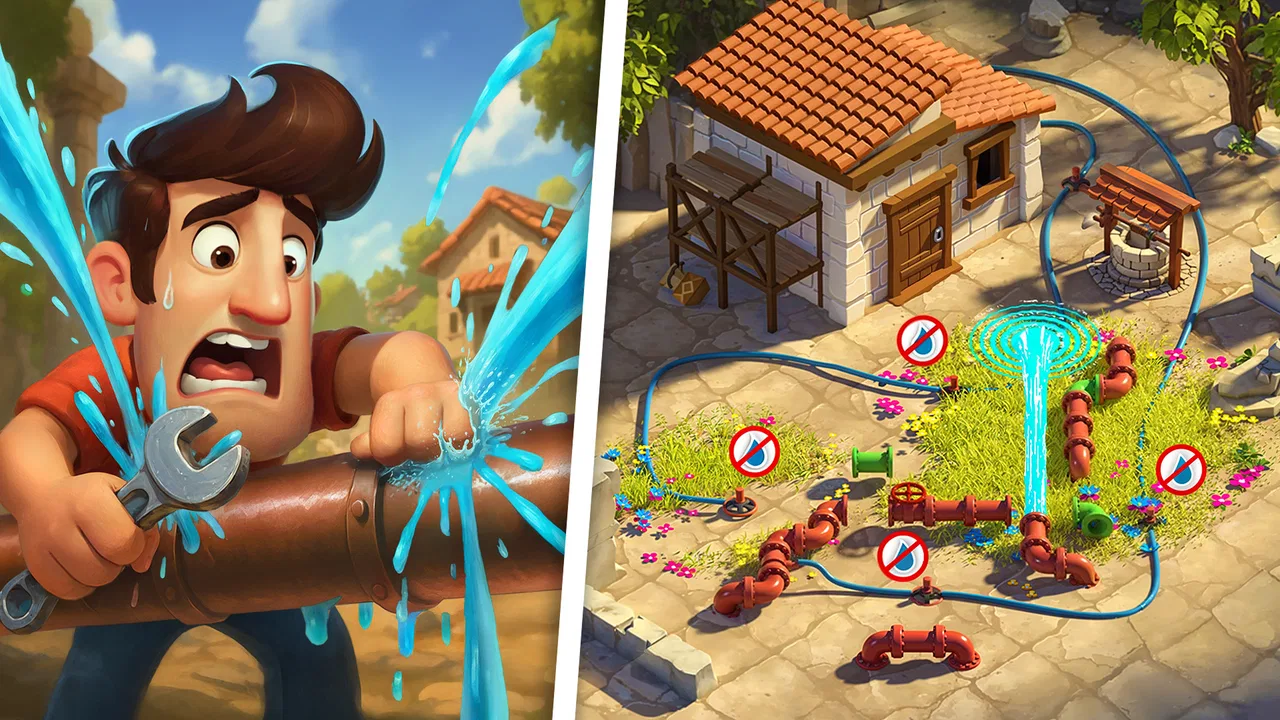
The water puzzles are a useful example of the game’s trade-off. They are approachable because the goal is visually understandable: connect the route correctly and make the system work. Yet they can become surprisingly fiddly when several pieces compete for attention. My best approach is to stop moving pieces randomly and first trace the route from the starting point to the destination. That simple habit reduces wasted attempts and makes the puzzle feel like a problem rather than a guessing exercise.
For tougher rooms, I recommend checking the entire board before committing to a move. Some layouts reward planning from the endpoint backward, especially when a route can be blocked by a piece that looked harmless at first. This is one of the more useful ways to play with a child or another family member: instead of giving the answer, ask them to identify where the path must finish. It turns a shared session into cooperation rather than one person taking control.
Progress, resources, and the cost of impatience
Diggy’s Adventure is free to start, which makes it easy to try without making a commitment. It also includes in-app purchases ranging from small amounts to much larger individual items. That range matters in a shared-device setting. A child may see a convenient purchase as a natural way to continue, while an adult may view it as an avoidable shortcut. I would decide the household rule before handing over the device, not after an accidental tap.
The game is more enjoyable when I treat resources as something to manage rather than something to rush through. If an obstacle can be approached in more than one way, I pause and consider whether spending now will make the next section easier or simply remove a moment of challenge. This is a less obvious strength of the design: the adventure gives me reasons to think about pacing, not only puzzle answers.
That same system can become friction for players who want a completely uninterrupted experience. Someone looking for a pure succession of clever riddles may dislike waiting, resource pressure, or the temptation to speed things up. A dedicated puzzle game is probably better for that person. Here, the adventure layer is part of the identity, and it sometimes asks for patience between satisfying discoveries.
Setting boundaries on a shared device
The game is rated Everyone, and its light, colorful presentation makes it approachable for a broad age range. That does not automatically mean every child will find every puzzle easy, or that every household should treat purchases casually. Age suitability and spending suitability are separate questions. I would be comfortable introducing it as a family-friendly adventure, while still keeping an adult aware of how the device is shared and who is allowed to approve purchases.
I would also avoid assuming that a shared login creates separate player spaces. The safest household routine is to agree on whose progress is being played before opening the game. If several people want distinct journeys, they should discuss how they will coordinate rather than repeatedly overwriting one another’s decisions. The game can support conversation and turn-taking, but that is a household arrangement, not something I would assume the app manages for me.
A practical routine is to give each player a clear turn and finish at a natural stopping point. That prevents the next person from inheriting a puzzle with no explanation. If the device is passed around frequently, taking a quick screenshot for personal reference may help, provided everyone understands that it is only a reminder and not a separate save system. I find this especially useful when two people are collaborating but do not play at the same time.
Playing together without turning it into a race
Diggy’s Adventure works well as a discussion game. One player can operate the controls while another studies the layout, spots a pattern, or remembers an earlier clue. This arrangement is better than having the most experienced player solve everything, because the game’s puzzles are more rewarding when everyone gets time to reason through them.
For younger players, I would use a “question first” rule. Before touching the board, ask what the goal appears to be, which pieces are fixed, and where the route probably needs to end. That keeps the child involved even when an adult has already recognized the solution. It also reveals whether the difficulty comes from the puzzle itself or simply from not knowing what the game is asking.
For adults sharing the device, coordination is less about teaching and more about preserving the fun. I would not search for a solution immediately after getting stuck. Instead, I would leave the puzzle and explore another available area if the game allows it, then return with a fresh view. That change of context is often more satisfying than using a hint at once, and it helps prevent one difficult room from making the whole adventure feel like work.
Where it compares well, and where another game may be better
Compared with a traditional escape-room app, this game offers more continuity. The puzzles are connected by exploration and story, so I get a stronger sense of progression than I would from a collection of unrelated rooms. Compared with a pure adventure game, it gives me more deliberate mental challenges and less emphasis on quick movement or combat-style action.
The compromise is that it may not satisfy either specialist completely. Escape-room fans who want dense, tightly authored logic puzzles could find the broader progression less focused. Players seeking a dramatic adventure may find the repeated puzzle structure slows the story. I would choose it for variety and a relaxed pace, not for the most demanding single puzzle design or the fastest narrative.
Its large player base suggests that the format has broad appeal: the game holds an average rating of 4.4 from around 536 thousand ratings, with over 10 million installs. Those figures do not change my personal experience, but they do fit what I noticed: it is easy to understand at first glance and flexible enough to attract both casual players and people who enjoy longer-term exploration.
Technical expectations and keeping the experience comfortable
The game was released on October 11, 2016, and the current version is 2.13.3. It supports devices running Android 7.0 or later. That makes checking the operating system worthwhile before planning to use an older household phone or tablet. On a shared device, compatibility is only one part of the question; available storage, battery condition, and whether the screen is comfortable for puzzle details also affect the experience.
I prefer playing on a device with enough screen space to inspect connections and small visual elements without constantly zooming mentally. A cramped display can make a simple layout feel harder than it is. If a child is playing, a stable surface is also better than passing the phone around while walking or eating, because the game rewards careful observation more than rapid tapping.
Because the game is free, trying it is straightforward. The more important decision is whether the household is comfortable with the included purchase range, which goes from forty-nine cents to nearly five hundred dollars per item. I would never leave that question to a young player’s interpretation. Establishing a no-purchase rule or requiring an adult check is sensible, especially when several people use the same device.
Who should play it and who should skip it
I recommend it to players who enjoy a gentle adventure with frequent puzzles, exploration, and a reason to return to unfinished areas. It is also a good choice for a parent, sibling, or friend who wants to solve things together without needing fast reactions. The Everyone rating and approachable presentation make it suitable for shared discovery, provided the adult handles account and purchase boundaries responsibly.
I would be more cautious about recommending it to someone who wants a short, completely self-contained game with no ongoing progression. It is not my first choice for a player who dislikes resource decisions, repeated puzzle structures, or the possibility of spending to accelerate progress. Likewise, people looking for a highly competitive multiplayer experience should look elsewhere; the appeal here is personal exploration and cooperation around the same screen.
It can also be a poor match for a household where everyone wants independent progress but nobody wants to coordinate. In that situation, a game with clearly separated profiles would be more convenient. I would not install this expecting the app itself to solve the social problem of shared saves. The better experience comes when players agree on turns, explain their stopping points, and respect the current explorer’s decisions.
My household verdict
After weighing the relaxing exploration against the resource and purchase friction, I see Diggy’s Adventure as a flexible family-friendly puzzle adventure rather than a pure escape-room title. Its best moments come when I study a room carefully, work out a route with someone else, and then see the wider journey open up. The combination gives casual sessions enough structure to feel worthwhile without demanding constant concentration.
My strongest advice is to treat the game as a shared activity with clear boundaries. Decide who is playing, agree on purchases, and encourage hints through questions instead of taking over the controls. Those small habits protect both the progress and the enjoyment. They also make the game useful for a household where different ages want to participate at their own level.
For me, the final recommendation is positive, with a clear condition: choose it if you want story-led exploration wrapped around accessible riddles, and accept that patience and coordination are part of the experience. If you want tightly packed escape puzzles, independent profiles, or a totally frictionless free game, another option will suit you better. For everyone else, the real strength is its ability to turn a shared screen into a conversation, one puzzle and one discovery at a time.
FAQs for Diggy's Adventure Puzzle Game
01What is the main objective of Diggy's Adventure: Escape Game?
Diggy's Adventure: Escape Game challenges players to solve complex puzzles while exploring ancient civilizations. The primary objective is to assist Diggy in uncovering hidden treasures and secrets by navigating through intricate mazes. Players must employ strategic thinking to progress through various levels, each filled with unique challenges and storylines.
02Is Diggy's Adventure free to play, and are there in-app purchases?
Yes, Diggy's Adventure is free to download and play on both Android and iOS platforms. However, it does include in-app purchases that allow players to enhance their gaming experience. These purchases can include additional energy, special items, and exclusive content that can help in progressing faster through the game.
03What are the system requirements for Diggy's Adventure on mobile devices?
To install Diggy's Adventure: Escape Game, players need a device running Android 4.4 or later, or iOS 9.0 or later. It’s important to have a stable internet connection for the best gaming experience, especially for downloading updates and accessing online features. Ensure your device has sufficient storage space to accommodate the app and its data.
04Can I play Diggy's Adventure offline?
Diggy's Adventure requires an internet connection to function properly, as it regularly updates with new quests and content that enhance gameplay. While some features might be accessible offline, playing online ensures full access to all game functionalities, including events, updates, and social features that connect with other players.
05How does the energy system work in Diggy's Adventure?
In Diggy's Adventure, the energy system dictates how much you can play in a single session. Energy is consumed when performing actions like digging or solving puzzles. It replenishes over time, but players can also use in-game currency or real money to purchase energy refills. Managing energy wisely is crucial to progressing efficiently.
Pros
- Engaging storyline with diverse characters.
- Challenging puzzles that stimulate the mind.
- Regular updates with new levels and events.
- Offline play available for on-the-go gaming.
- Intuitive controls make navigation easy.
Cons
- Energy system limits playtime.
- In-app purchases can become costly.
- Some puzzles are very difficult.
- Occasional bugs disrupt gameplay.
- Requires significant storage space.

Diggy's Adventure Puzzle Game
Gallery